
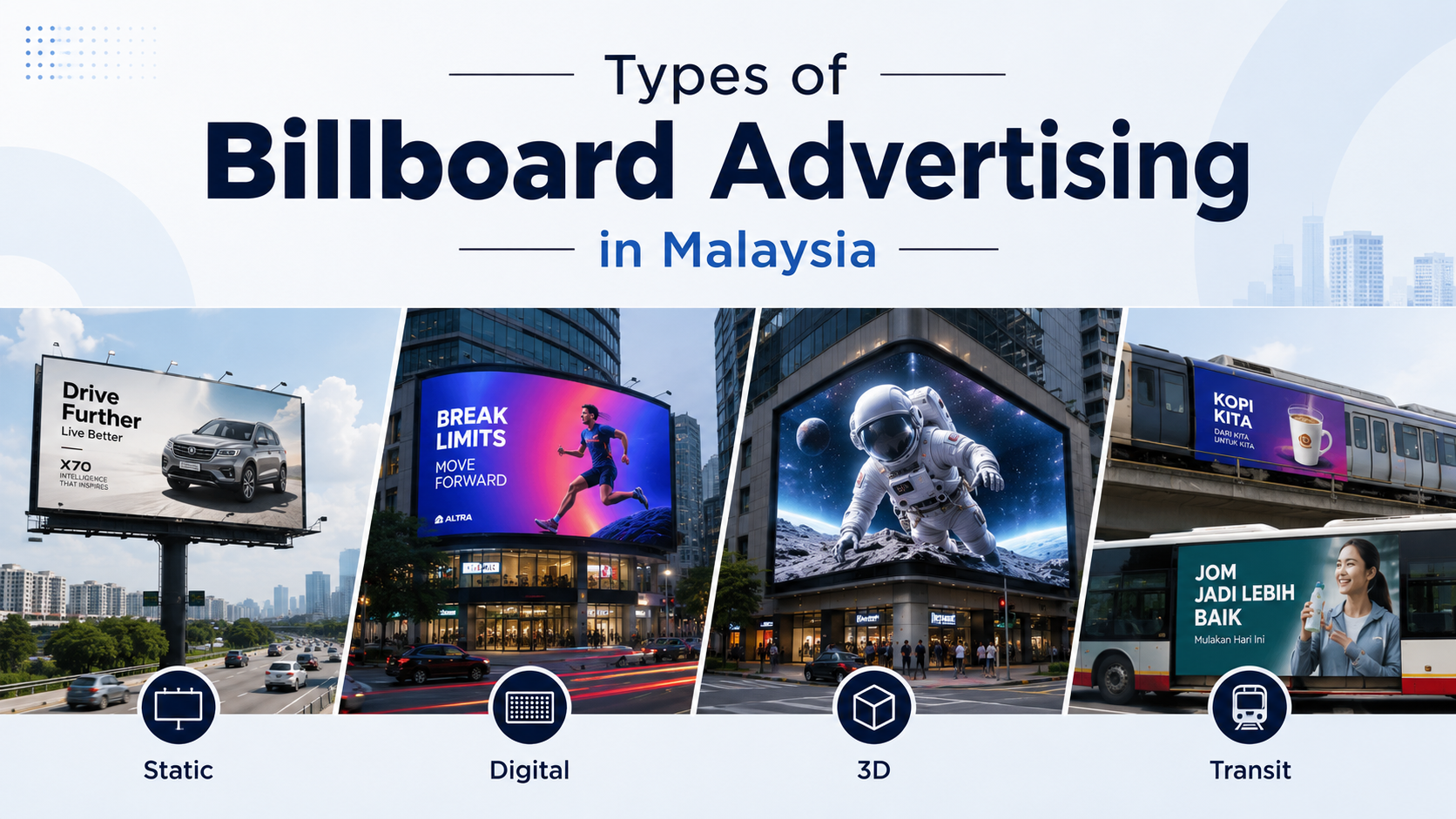
Billboard and out-of-home advertising come in several formats, with each one serving a different campaign purpose. Static billboards provide continuous exposure, while digital screens allow brands to update their content more easily. Meanwhile, 3D displays create high-impact visual experiences, and transit advertising reaches audiences across multiple routes.
The right format depends on the campaign objective, target audience, preferred location, creative requirements, duration and available budget. Therefore, businesses should understand how each option works before selecting an outdoor advertising format in Malaysia.
Billboard Advertising Formats at a Glance
| Format | Best Suited For | Main Advantage | Main Limitation |
|---|---|---|---|
| Static billboard | Long-term brand awareness | Continuous visibility | Artwork cannot be updated quickly |
| Digital billboard | Promotions and product launches | Flexible campaign content | Display time is usually shared |
| 3D billboard | High-impact brand campaigns | Memorable visual presentation | Requires specialised creative production |
| Transit advertising | Broad commuter exposure | Reaches audiences across several locations | Viewing conditions vary by route |
Static Billboards
Static billboards are large printed advertisements installed in fixed locations. Throughout the campaign period, the same artwork remains visible without rotating with advertisements from other brands.
This format commonly supports long-term brand awareness, property campaigns, corporate messaging and advertisements that do not require frequent updates. In addition, static billboards provide dedicated advertising space for one campaign.
Advantages of static billboards:
- Continuous exposure: The advertisement remains visible throughout the booking period.
- Dedicated advertising space: The display does not rotate with other brands.
- Consistent brand presence: Repeated exposure can strengthen campaign recognition.
- Suitable for longer campaigns: The format works well when the message remains relevant over time.
Limitations of static billboards:
- Limited flexibility: Updating the message requires new artwork, printing and installation.
- No motion or animation: The advertisement depends entirely on one fixed visual.
- Additional production requirements: Printing and installation should form part of the overall campaign budget.
Overall, static billboards suit businesses that want one clear message to remain visible continuously.
Digital Billboards
Digital billboards use LED screens to display images, animation and video. Several advertisers may share the same screen, with each advertisement appearing according to a scheduled rotation.
Because advertisers can update the content without replacing printed artwork, digital billboards work well for product launches, seasonal campaigns, promotions and time-sensitive messages.
Advantages of digital billboards:
- Flexible content updates: Campaign messages can change more quickly.
- Multiple creative versions: Brands can display different products, promotions or campaign phases.
- Motion and animation: Digital screens provide more creative presentation options.
- Suitable for shorter campaigns: Advertisers may be able to purchase scheduled display slots.
Limitations of digital billboards:
- Shared display time: Advertisements normally rotate with content from other brands.
- Limited viewing duration: Each message may only appear for several seconds.
- Technical dependency: Screen malfunctions, software issues or power disruptions may affect the display.
- Higher costs at premium locations: Major digital screens in high-demand areas may require a larger budget.
As a result, digital billboards are most suitable for campaigns that require flexibility, changing content or dynamic creative work.
3D Billboards
A 3D billboard usually displays specially produced content on a large digital screen to create the illusion of depth. This technique is often known as anamorphic advertising because the effect works best from a particular viewing position.
Rather than using a completely separate billboard structure, many 3D campaigns rely on digital LED screens and customised animation.
Advantages of 3D billboards:
- Strong visual impact: The depth effect can make the campaign more noticeable.
- Memorable presentation: An unusual visual experience may improve campaign recall.
- Social media potential: Viewers may record the display and share it online.
- Suitable for major launches: The format can support product reveals, entertainment campaigns and premium activations.
Limitations of 3D billboards:
- Specialised creative production: The artwork requires technical planning and animation expertise.
- Viewing-angle dependency: The effect may appear strongest from selected positions.
- Limited site availability: Not every digital screen supports an effective 3D presentation.
- Larger campaign investment: Creative development and premium placement may increase the overall cost.
Consequently, 3D billboards usually suit brands seeking a distinctive campaign moment rather than basic long-term exposure.
Transit Advertising
Transit advertising places advertisements on or around public transportation. Common examples include buses, trains, taxis, stations and transport shelters.
Although transit advertising belongs to the wider OOH category rather than fixed roadside billboards, it remains an important advertising format in Malaysia. Furthermore, it allows brands to reach commuters across several locations.
Advantages of transit advertising:
- Mobile exposure: Vehicle advertisements travel through different areas and neighbourhoods.
- Repeated commuter visibility: Regular passengers may see the campaign several times.
- Flexible format options: Advertisements can appear on vehicle exteriors, interiors, stations or shelters.
- Broad geographical reach: Transit campaigns extend exposure beyond one fixed site.
Limitations of transit advertising:
- Changing viewing conditions: Visibility depends on traffic, routes and the surrounding environment.
- Limited viewing time: Audiences may only see the advertisement briefly.
- Route dependency: Campaign reach depends on where the transport service operates.
- Less control over the environment: Other vehicles, structures or crowds may affect visibility.
For this reason, transit advertising can support businesses that want to reach commuters and audiences across several urban areas.
Are There Other OOH Advertising Formats?
Beyond these four main formats, businesses may also consider:
- Street furniture
- Bus shelters
- Building wraps
- Wall-mounted advertisements
- Gantry billboards
- Unipole billboards
- Airport advertising
- Retail and indoor digital screens
- Cinema advertising
Each format serves a different audience and viewing environment. For example, airport advertising reaches travellers, whereas retail media connects with customers closer to the point of purchase.
Which Billboard Format Should You Choose?
The most suitable format depends on what the campaign needs to achieve.
For Continuous Long-Term Visibility
A static billboard is usually appropriate when the campaign requires one consistent message, dedicated advertising space and continuous exposure over an extended period.
For Promotions and Changing Content
Digital billboards work better when brands need frequent updates, animated visuals, several creative versions or time-sensitive campaign information.
For High-Impact Product Launches
A 3D billboard may support campaigns that rely on visual spectacle, distinctive creative execution and social media sharing. However, the selected screen must support anamorphic content effectively.
For Broad Commuter Reach
Transit advertising can help brands reach daily commuters across multiple routes. It may also complement fixed billboard placements by extending the campaign into different urban areas.
Ultimately, no single format is automatically better than the others. The correct choice depends on the audience, objective, location and available budget.
Can a Campaign Use More Than One Format?
Yes. Combining several formats can help one campaign meet different objectives.
For instance, a static billboard can maintain consistent brand visibility, while digital screens promote changing offers. At the same time, transit advertising can extend campaign exposure across commuter routes.
However, businesses should avoid adding formats without a clear purpose. Instead, every placement should support the target audience, geographical coverage and campaign objective.
What Should Businesses Consider Before Booking?
Before selecting a billboard or OOH format, review:
- Campaign objective
- Target audience
- Preferred locations
- Campaign duration
- Available budget
- Creative requirements
- Visibility and viewing distance
- Traffic or pedestrian movement
- Production requirements
- Measurement approach
Although a large premium display may appear attractive, it is not always the most effective option. A strategically selected placement with a relevant audience may provide stronger campaign value.
Frequently Asked Questions
What is the most common type of billboard advertising?
Static and digital billboards are among the most widely recognised formats. The better option depends on whether the campaign requires continuous exposure or flexible content.
Are digital billboards better than static billboards?
Neither format is automatically better. Digital billboards provide greater flexibility, while static billboards give one advertiser uninterrupted exposure.
Are 3D billboards actual three-dimensional structures?
Many 3D billboard campaigns use anamorphic creative content displayed on digital LED screens. The visual creates an illusion of depth when viewed from the correct angle.
Which billboard format is suitable for long-term campaigns?
Static billboards are generally suitable for long-term campaigns because the same advertisement remains continuously visible.
Which format is suitable for product launches?
Digital and 3D billboards may support product launches because they allow dynamic content and visually impactful presentations.
Can small businesses use billboard advertising?
Yes. Small businesses can consider focused static locations, scheduled digital slots, transit formats or smaller outdoor displays based on their budgets and target areas.
Plan Your OOH Campaign with Big Network Media
Understanding the different types of billboard advertising in Malaysia helps businesses choose a format that supports their campaign goals.
Static billboards provide continuous exposure, digital billboards offer flexibility, 3D campaigns create visually distinctive experiences, and transit advertising reaches mobile audiences across several locations.
Big Network Media Sdn Bhd helps businesses compare OOH media formats, identify suitable locations and coordinate campaigns according to their audiences, objectives and budgets.
Contact Big Network Media to discuss the right billboard and outdoor advertising format for your next campaign.